


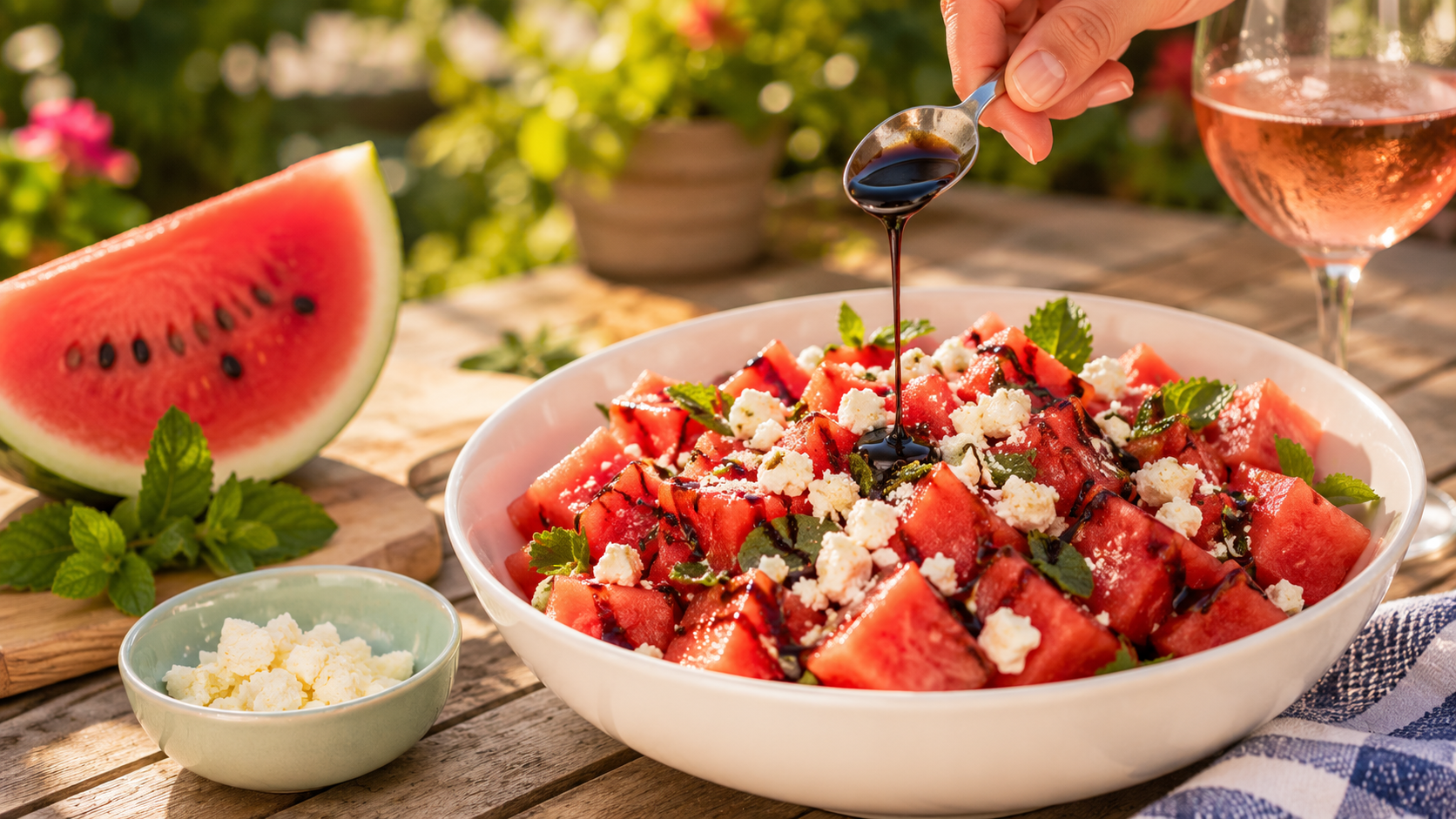
So every summer I have a moment — usually sometime in mid-July — where I buy a watermelon that’s so heavy I can barely carry it to the car, and I’m so pleased with myself about this watermelon that I stand at the kitchen counter and cut it open right away and eat a slice standing there before I’ve even put the grocery bags away. And every summer that moment reminds me that peak watermelon is one of the most perfect foods that exists, and it doesn’t need a single thing done to it to be extraordinary, you know?
Here’s the thing,g though — watermelon and feta together is a different kind of extraordinary. It’s the combination that sounds wrong on paper until you taste it, and then it sounds like the most obvious thing in the world. The sweet cold watermelon against the salty creamy feta, brightened with fresh mint and lime, finished with olive oil and flaky salt — it’s four ingredients doing something that genuinely adds up to more than their individual parts. I’ve been bringing this salad to every summer gathering for three years, and without fail, without a single exception, it’s the first platter that empties and the first recipe someone asks about, you know?
This is the full breakdown — the base recipe, the technique details that make it look and taste as good as it can, and every variation I’ve tested over three summers of making it constantly.
Prep time: 10 minutes Assembly time: 5 minutes Serves: 6 to 8 as a side
What You Need
For the salad: Half a large seedless watermelon — about 8 cups of cubed or sliced fruit. Look for a watermelon with a yellow spot on the bottom where it rested on the ground — that yellow patch means it ripened on the vine, which means it’s genuinely sweet, you know? 6 to 8 ounces of good quality feta cheese — buy the block packed in brine, not the pre-crumbled kind in a plastic container. The block feta is creamier, more flavorful, and crumbles more beautifully when you break it by hand. The pre-crumbled version is drier and sharper and doesn’t do this salad justice. A generous handful of fresh mint leaves — torn by hand at the very last moment.t Half a small red onion, very thinly sliced — optional but adds a sharpness that I love against the sweet watermelon
For the dressing: Juice of one large lime—or half a lemon if that’s what you have 2 tablespoons of your best olive oil—this is a salad where the olive oil is tasted directly, use one you like A pinch of flaky sea salt—not table salt, flaky salt specifically because the larger crystals provide little bursts of salinity against the sweet watermelon that table salt can’t replicate Cracked black pepper Optional: a tiny pinch of red pepper flakes or Tajín seasoning for a little heat contrast Optional: a drizzle of honey if your watermelon isn’t as sweet as you’d like
The Technique — Which Matters More Than You’d Think
How you cut the watermelon changes everything. And I say this as someone who spent two years cutting it into cubes and wondering why the salad looked slightly less beautiful than I wanted it to. Here are the three options,s and when I use each one.
Triangles or thick wedges — cut the watermelon into slices, then cut each slice into triangles. This is the most dramatic, visually impressive presentation and the one I use when I want the platter to look genuinely stunning at a party or a cookout. The wedges create height and drama and natural places for the feta to nestle. It’s also the easiest cut because you don’t have to be precise about anything.
Large cubes—roughly one-and-a-half- to two-inch cubes. This is my everyday version, the one that works in a bowl or on a platter, travels reasonably well, and eats most easily with a fork. The larger size matters—small cubes turn into something mushy and waterlogged much faster than large cubes, you know?
Thin slices layered on a platter — use a sharp knife to cut the watermelon into half-inch slices, then arrange them overlapping across a wide flat platter or board. This is the most elegant presentation and the one I use for adult dinner parties or occasions where presentation is part of the point. It takes about three more minutes than the triangle method, and the result is noticeably more beautiful.
Pat the watermelon dry before dressing it. Watermelon releases liquid almost the moment it’s cut and salted, which dilutes everything and makes the salad watery. A quick, gentle pat with paper towels on the cut surfaces—not rubbing, just pressing—removes surface moisture and gives the olive oil and lime juice somewhere actually to land, rather than slipping off the wet fruit. This one step keeps the salad from turning into a pool of pink liquid at the bottom of the platter, you know?
The red onion needs to be thinly sliced and ideally soaked. If you’re using red onion — and I recommend it for the sharpness it adds — slice it very thin on a mandoline or with a sharp knife and soak the slices in cold water for ten minutes before adding them. This process takes the aggressive raw bite off the onion and leaves a gentler, slightly sweet, sharpness that complements rather than overpowers everything else. Ten minutes in cold water, drain, pat dry, and scatter over the salad. That’s it.
Dress right before serving, not before. The dressing goes on at the absolute last possible moment—right as it goes to the table, not sitting in the fridge for an hour waiting. The lime juice starts pulling moisture from the watermelon the second it makes contact, and the whole salad gets increasingly watery the longer it sits dressed. Make everything ahead, store the components separately, and dress at the table or right before serving, you know?
Assembly
Arrange the watermelon on your widest, flattest serving platter—not a deep bowl where everything piles up, but a wide platter where it can spread out and be seen. Scatter the soaked, dried red onion slices over the watermelon. Break the feta block into generous,s irregular pieces directly over the platter—use your fingers or two forks to create rustic chunks of different sizes rather than uniform crumbles. The irregular pieces look more beautiful and give you different amounts of feta in different bites, which is part of what makes this salad interesting to eat, you know?
Now address it. Drizzle the lime juice over everything, then the olive oil in a thin stream over the feta and watermelon. Finish with the flaky sea salt — be generous, the salt is doing real work, re bringing out the sweetness of the watermelon and amplifying the brininess of the feta. Cracked black pepper over the top.
Tear the fresh mint leaves directly over the platter — large pieces, not minced or chopped. The torn leaves look beautiful and release their fragrance as they tear, which is part of the sensory experience of the salad, you know? Add the red pepper flakes or the drizzle of honey if you’re using either.
Serve immediately and eat it within thirty minutes of assembling.
Julia’s Real Tips — The Details That Matter
Block feta packed in brine is the only feta for this salad. I’ve made this point above, and I’m making it again because it’s the most important ingredient decision in the recipe. The brine-packed block is a completely different product from pre-crumbled feta—creamier, more complex in flavor, with a texture that breaks into satisfying pieces rather than dry, dusty crumbles. Find it at any grocery store in the specialty cheese section or in a small tub with brine liquid. It’s worth finding, you know?
Lime over lemon, usually. Both work and both are good. Lime has a slightly more tropical brightness that I find goes better with watermelon’s sweetness. Lemon has more acidity and a sharper flavor that works beautifully if you want the salad to feel more Mediterranean. I use lime for cookouts and casual summer gatherings, and lemon when I’m serving it alongside grilled fish or as part of a more composed dinner, you know?
The thirty-minute window. This salad has a peak moment, and it lasts about thirty minutes from assembly. In that window, the flavors have had time to come together, but the watermelon hasn’t released enough liquid to dilute everything. Before thirty minutes, it’s a little separate and cold and needs a minute to wake up. After about forty-five minutes, it starts getting slightly watery. Assemble it, put it on the table, and eat it. That’s the contract.
Double the mint. Whatever amount of mint you think looks like enough, add more. Mint is the herb that makes this salad taste fresh and alive rather than just sweet and salty. A generous, confident handful of torn mint over the top is the difference between a good version and an OH MY GOSH version, you know?
Make it into a meal. A few additions turn this side salad into a light summer lunch. Add a cup of cooked quinoa tossed with olive oil at the base before the watermelon goes on. Add sliced prosciutto draped loosely over the platter. Add a handful of arugula underneath everything for peppery contrast. Add sliced cucumber alongside the watermelon for extra crunch. Any of these takes the salad from a beautiful side dish into something more substantial without changing what makes it work.
The Variations I Make All Summer
Watermelon, feta & basil: Swap the mint for fresh basil and the lime for lemon. Add a drizzle of balsamic glaze over the top instead of the olive oil alone. This version tastes more Italian than the original and pairs beautifully with grilled chicken or fish, you know?
Watermelon, feta & cucumber: Add two English cucumbers, thinly sliced, alongside the watermelon. The cucumber extends the salad, adds crunch, and gives the whole thing more volume for feeding a larger crowd. This is my go-to version for parties where this needs to be a more substantial side, you know?
Spicy watermelon feta: Add one jalapeño, very thinly sliced, scattered over the top. The heat against the sweet cold watermelon is genuinely one of summer’s great flavor contrasts. Add a drizzle of honey alongside to balance the heat. This is the variation Dan requests specifically, and it’s been on our regular summer rotation for two years.
Watermelon, feta & avocado: Add one ripe avocado, sliced or cubed, right before serving. The creamy avocado adds richness that makes the salad feel more substantial, and the combination of creamy avocado, salty feta, and sweet watermelon is a trio that works surprisingly beautifully together, you know?
Grilled watermelon version: Cut the watermelon into thick one-inch slices and grill directly on the grate over high heat for two to three minutes per side until grill marks appear and the edges caramelize slightly. Let cool for five minutes, then cut into pieces and assemble the salad as usual. The grilling concentrates the sweetness and adds a subtle smoky note that transforms the whole salad into something more complex and dinner-appropriate. This is the version I make for adult dinner parties when I want the salad to feel more considered and interesting, you know?
Chef’s Notes — Family Verdict
So here’s the story of the first time I served this salad. I made it for a neighborhood cookout three summers ago, and I set it out on the table and walked away to check on something on the grill. When I came back about twelve minutes later, the platter was empty, and three separate people were standing near where it had been, looking slightly disappointed. I’d made enough for twenty people. Twelve minutes.
I’ve since made it for every summer gathering I’ve hosted or attended, and the result is consistently the same—it goes first, it goes fast, and people ask about it. The question I get most often is some version of “How did you know to put those things together?” and the honest answer is that I didn’t come up with it—it’s a classic Mediterranean combination that’s been around forever—but the way I make it, with the block feta and the fresh mint and the flaky salt and the wide platter presentation, does something that makes it feel like more than the sum of its parts, you know?
Maya helped me make it last summer and has since developed a strong position that she prefers the cucumber version “for texture reasons.” She said that with complete seriousness. I respect it enormously. Jake will not eat it because it contains both fruit and cheese in the same place, which violates principles he holds deeply. Dan eats it at every cookout and has started specifically asking if I’m bringing “the watermelon thing” before confirming his attendance at neighborhood events.
That platter at the center of the table, going from full to empty faster than anything else, is honestly one of my favorite things to watch happen all summer. Five ingredients, ten minutes, three summers of reliable perfection. That’s the recipe.
You’ve absolutely got this. Find a good watermelon this weekend.
— Chef Julia












Discussion about this post