


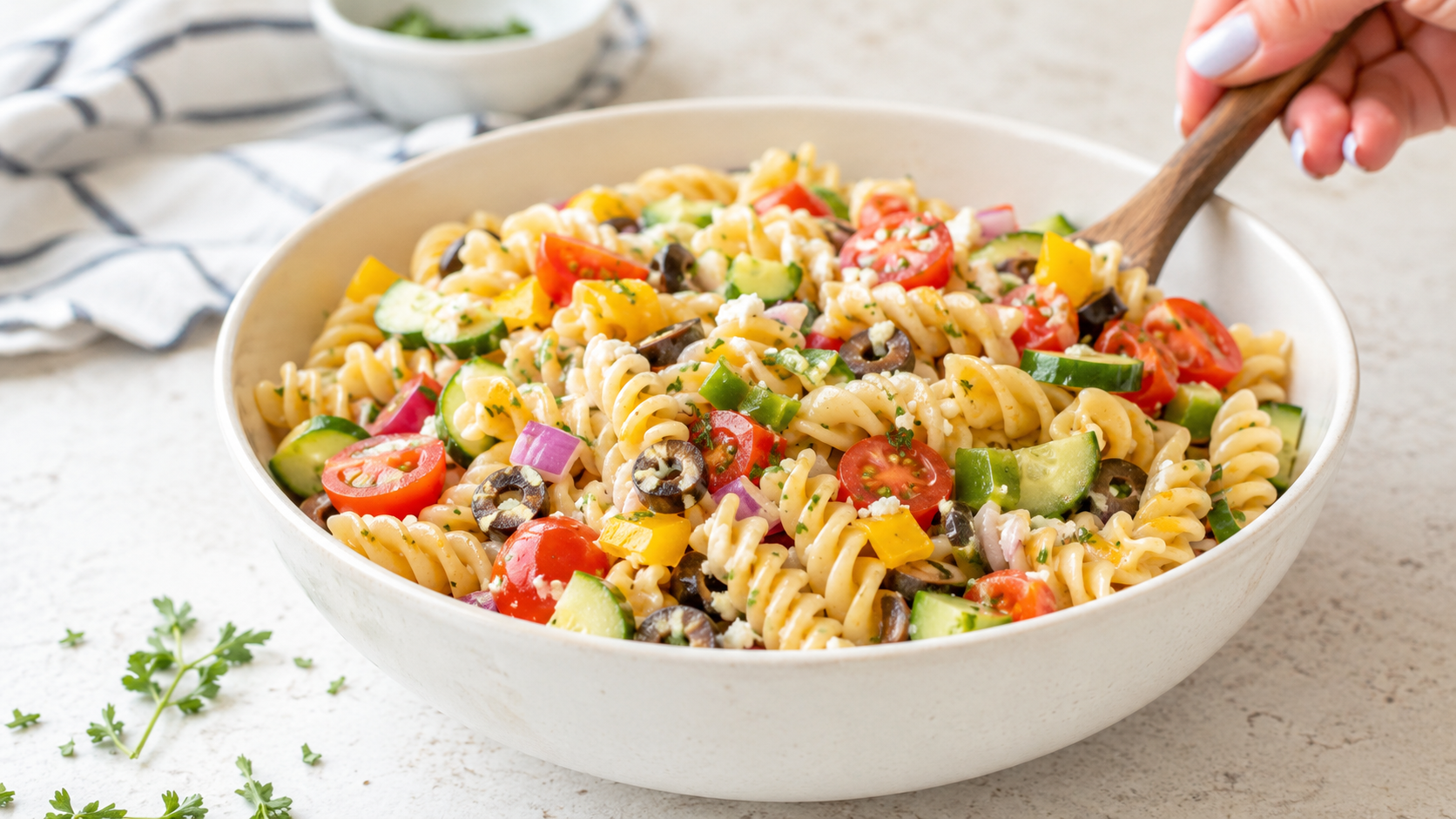
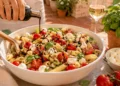
So it’s a Tuesday in late June, the kind of afternoon where the air conditioning in our house is fighting a losing battle against the Chicago heat, and I open the fridge to figure out dinner. I’ve got half a box of rotini, some cherry tomatoes that need to be used today, a block of feta, a cucumber, some olives, and a jar of pepperoncini that’s been living in the back of that fridge since approximately last summer. Thirty minutes later, I’ve got a bowl of cold pasta salad that both kids ate without a single complaint, that Dan went back for seconds of, and that somehow tasted like I’d been planning it all along. That’s the magic of cold pasta salad, you know?
Here’s the thing about this recipe that I want to be completely upfront about—it’s not fussy. It doesn’t require technique. It doesn’t require special equipment or a trip to a specialty grocery store. What it does require is one genuinely important step that most recipes mention and then rush past: dressing the pasta while it’s still warm. That one step is the entire difference between pasta salad that tastes like cold pasta with stuff on it and pasta salad that tastes like it was actually made on purpose. I learned it the hard way after years of making the second version, and I’m going to make sure you skip straight to the first.
This is the base recipe I make all summer long. After the base, I’ll give you four variations so you can take it in completely different directions depending on what’s in your fridge, what you’re in the mood for, and who you’re feeding.
Prep time: 15 minutes Cook time: 10 minutes for the pasta Chill time: At least 1 hour; overnight is better Serves: 6 to 8 as a side, 4 as a main
What You Need
For the pasta: 1 pound of rotini, fusilli, or farfalle—shapes with ridges and curves that hold onto dressing. Please don’t use spaghetti or penne for this; the shape genuinely matters, you know? 1 tablespoon of salt for the pasta water—the water should taste like the sea, not like a gesture
For the mix-ins: 1 English cucumber, quartered lengthwise and chopped 1 and a half cups of cherry tomatoes, halved Half a red onion, very finely diced One cup of Kalamata olives, halved One cup of crumbled feta cheese Half a cup of pepperoncini peppers, sliced Half a cup of sun-dried tomatoes in oil, roughly chopped A big handful of fresh basil, torn by hand right before serving
For the Greek-style vinaigrette: Half a cup of good olive oil—this dressing is simple enough that the olive oil quality is actually noticeable, so use one you like the taste of. 3 tablespoons of red wine vinegar, 1 tablespoon of fresh lemon juice, 2 cloves of garlic, very finely minced or grated on a microplane, 1 teaspoon of Dijon mustard, 1 teaspoon of dried oregano, half a teaspoon of honey, salt, and black pepper—taste and adjust, always
Let’s make it.
Start with the dressing. Make it first, before the pasta goes on, before anything else. Whisk the olive oil, red wine vinegar, lemon juice, garlic, Dijon, oregano, and honey together in a large bowl if you’ll be using it for the whole salad. Season it generously with salt and pepper and taste it. It should be bright and tangy and boldly seasoned—it needs to be a little more intense than feels right on its own because it’ll be coating a full pound of pasta, and everything mellows once it’s all mixed together, you know?
Cook the pasta. Get a large pot of water boiling with a genuinely generous amount of salt. Cook the pasta to al dente—just tender with a little bite remaining. Not soft, not mushy. One minute less than the package says is usually right. You want slightly underdone pasta because it continues to absorb dressing as it sits and chills, and what starts as perfectly al dente will be perfectly tender by serving time. Overcooked pasta turns soft and a little sad as it sits cold, you know?
Now here’s the step that changes everything. Drain the pasta, but do not rinse it. I know every instinct says to rinse it to cool it down fast, and I know almost every pasta salad recipe tells you to do exactly that. Don’t. Rinsing washes off the starch on the surface of the pasta, and that starch is what helps the dressing actually cling to each piece instead of pooling at the bottom of the bowl. Drain it, shake off the excess water, and immediately — while it’s still hot and steaming — pour it directly into the bowl with the dressing. Toss well so every single piece is coated. The warm pasta drinks the dressing. This is the whole secret right here.
Let the pasta cool to room temperature in the dressing, tossing it again once or twice as it cools. Don’t rush this by putting it in the fridge while it’s still hot — let it cool naturally for about fifteen to twenty minutes, tossing occasionally so it doesn’t clump together.
Now add everything else. Once the pasta is at room temperature, add the cucumber, cherry tomatoes, red onion, olives, pepperoncini, and sun-dried tomatoes. Toss gently to combine. Taste it—this is important. Taste it now before the feta and basil go in, and adjust the seasoning. It might need more salt, more vinegar, and a little more olive oil. Get it exactly where you want it now.
Fold in the crumbled feta last and gently—you want visible pieces of feta throughout, not feta that’s been crumbled into dust by over-stirring. Cover and refrigerate for at least one hour. Overnight is genuinely better, and I’ll keep saying that until everyone believes me.
Right before serving, taste it again and adjust. Cold dulls flavors, so pasta salad almost always needs a little extra salt and a fresh drizzle of olive oil after chilling. Tear the fresh basil over the top at the last possible second—basil turns dark and sad if you add it too early, and that’s a shame, you know?
Julia’s Real Tips from Fifteen Years of Making This
Salt your pasta water properly—a full tablespoon of salt in a large pot of water. The pasta absorbs that seasoning as it cooks, and it’s the foundation of the whole dish’s flavor. Under-salted pasta makes under-flavored pasta salad, and no amount of dressing fixes it after the fact.
The overnight difference is real. A one-hour chill gives you a good pasta salad. An overnight chill gives you the pasta salad people ask about. The pasta continues to absorb the dressing; the garlic mellows; the vegetables release a little juice that seasons everything—the whole thing comes together in a way that doesn’t happen in an hour. Make it the night before whenever you possibly can.
Reserve a little dressing on the side. Before you pour all the dressing over the hot pasta, pull out about three tablespoons and set them aside in a small bowl. This is your finishing dressing for right before serving, after the chilling has done its work. Fresh dressing at the end brightens everything back up.
Don’t crowd the bowl. Use a bigger bowl than you think you need. Pasta salad that’s being tossed in a too-small bowl always ends up with half the toppings on the counter instead of in the salad. I’ve cleaned that counter too many times, you know.
Add delicate ingredients at the end. Anything that releases water quickly — cucumber, fresh tomatoes, fresh herbs — goes in last. They’ll soften and weep into the salad if they sit too long in the dressing, and you want them to stay fresh and textural at serving time.
Four Variations Worth Knowing
Italian antipasto style: Swap the feta for fresh mozzarella balls or cubed provolone. Replace the Kalamata olives with a mix of green and black olives. Add thinly sliced salami or pepperoni, roasted red peppers from a jar, and fresh basil and parsley. Use the same vinaigrette or a simple Italian dressing. This is the version I bring to potlucks, and it’s the one that comes home empty every time, you know?
BLT pasta salad: This one sounds too simple to be this good, and yet here we are. Cook and crumble eight strips of bacon. Add cherry tomatoes, chopped romaine lettuce, and shredded cheddar just before serving. For the dressing, swap the Greek vinaigrette for a simple combination of mayonnaise, a little apple cider vinegar, garlic powder, salt, and pepper—more of a creamy ranch dressing. Jake’s personal favorite variation by a significant margin. He requests this one by name.
Sun-dried tomato and artichoke: Use the Greek vinaigrette base but add a jar of quartered artichoke hearts, extra sun-dried tomatoes, fresh spinach leaves instead of basil, pine nuts toasted in a dry pan, and shaved parmesan instead of feta. A drizzle of balsamic glaze right before serving ties it all together. Maya calls this one “the fancy version” and requests it when she has friends coming over.
Summer corn and avocado: This is the lightest, brightest version, and it’s perfectly tuned for peak August. Use a lime-based vinaigrette instead—lime juice, olive oil, a little honey, garlic, and cumin. Add fresh corn cut straight off two cobs, diced avocado added right before serving, cherry tomatoes, black beans, red onion, cilantro, and cotija cheese. Skip the olives and pepperoncini. This one tastes more like a summer meal than traditional pasta salad, and it’s seriously amazing on a hot evening when you genuinely don’t want anything cooked or heavy.
How to Serve It
So, in our house, this pasta salad does about four different jobs, depending on the situation. It’s the side dish at every summer cookout—it travels well, holds up sitting outside in the heat, and feeds a crowd without any last-minute work at the party. It’s a weeknight dinner on nights when nobody wants anything. Just pull it out of the fridge, adjust the seasoning, add the fresh basil, and you’re done. It’s Maya’s requested contribution to any school event or potluck situation. And it’s the thing I make on Sunday when I want lunches covered for the first part of the week—it keeps beautifully for three days in the fridge, getting better each day, you know?
Serve it cold, straight from the fridge, in a big, wide bowl with tongs or a large spoon alongside. Fresh basil right at the end. A drizzle of your best olive oil if you’re feeling generous. That’s it.
Chef’s Notes — Family Verdict
OH MY GOSH, the summer I finally figured out the warm-pasta-meets-dressing technique, everything changed. I’ve been making pasta salad since cooking school, and somehow it took me years to really internalize that one step. The version I was making before was fine. The version after that discovery was the one people followed me into the kitchen to ask about.
Dan eats this for lunch three days in a row every time I make a batch and never once suggests we should have something else. That is the highest endorsement in our house. Jake picks out the olives and pepperoncini with practiced efficiency—I’ve long since stopped hiding them because he finds them every time—but eats everything else happily. Maya takes the leftovers to school in a container and comes home, saying her friends wanted to know what she was eating. I’ll take every bit of that, you know?
The recipe is flexible, forgiving, infinitely adaptable, and gets better the longer it sits. That combination right there is everything a working mom needs from a summer recipe. Make it tonight. Eat it all week.
You’ve absolutely got this.
— Chef Julia







Discussion about this post